
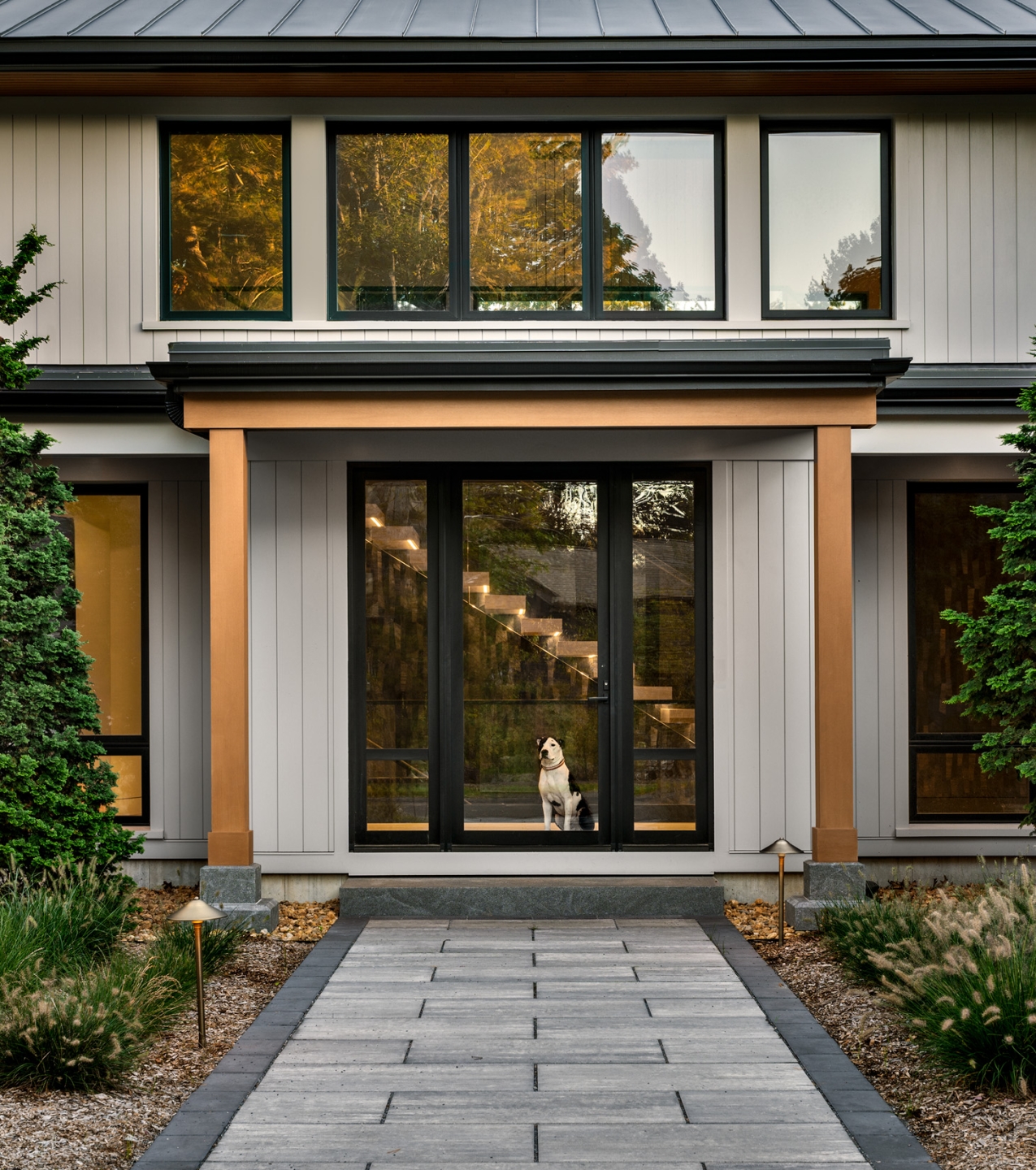
Sustainability: Passive Design Strategies for New England Buildings
Sustainability is often discussed in terms of technology. Solar panels, high efficiency mechanical systems, and new materials are often what come to mind first. While these elements can play an important role, sustainable design begins much earlier. It begins with the way a building is placed on the land, how it is shaped, how it captures light, and how it responds to climate.
At SP Architects, sustainability is not treated as an add-on, but as a design principle that informs decisions from the very beginning. The goal is not just energy efficiency, but buildings that belong to their place, that age well, and that serve generations.
Sustainability has many layers. It includes energy use, materials, and environmental impact, but it also includes longevity, durability, and the relationship between a building and its landscape. A truly sustainable building is one that feels as though it belongs where it stands and will continue to perform well over time.
Building in New England: Designing for Climate and Place
Designing in New England requires careful consideration of climate. Cold winters, humid summers, coastal winds, snow loads, and freeze and thaw cycles all influence how buildings must be designed and constructed.
Historically, many New England building styles evolved as direct responses to these conditions. Compact forms like the Cape Cod reduced heat loss. Steep roofs shed snow. Shingle style buildings used materials that could withstand coastal weather. These buildings were shaped by climate and necessity, and for that reason, many of them have endured for generations.
This regional history offers an important lesson. Buildings that respond to their environment tend to last longer, perform better, and feel more appropriate to their surroundings.
What Is Passive Design?
Passive design is an approach that uses a building’s site, orientation, form, materials, insulation, and windows to naturally regulate temperature, light, and airflow. The goal is to maintain comfort while reducing the need for mechanical heating, cooling, and lighting.
In New England, some of the most effective passive design strategies include:
- Orienting the building to take advantage of southern sunlight
- Designing a highly insulated and well sealed building envelope
- Placing and sizing windows to capture winter sun while limiting summer heat gain
- Using roof overhangs or shading devices to control seasonal sunlight
- Designing for natural cross ventilation
- Selecting durable materials suited to moisture, wind, and temperature changes
When these strategies are considered early in the design process, the result is a building that feels comfortable and light filled while quietly using less energy.
The Lifecycle of Passive Design
Sustainability is not only about how a building performs when it is new, but how it performs over time. Lifecycle thinking considers durability, maintenance, energy use, and adaptability.
Materials should age well. Systems should be efficient and long lasting. Spaces should be flexible enough to accommodate changes in how people live over time. The most sustainable building is often the one that does not need to be replaced, but instead continues to serve its occupants for decades.
Sustainability as Harmony
Ultimately, sustainability is about harmony between a building, its environment, and the people who use it. A sustainable building should sit comfortably within its landscape, respond to climate, use materials responsibly, and be built to last.
In many of our residential projects, passive strategies such as building orientation, deep roof overhangs, careful window placement, and high performance building envelopes are considered from the earliest conceptual stages. Rather than treating sustainability and design as separate goals, we see them as closely connected. The shape of the building, the way light enters a room, and the way a structure meets the land all contribute to how a building performs over time.
Passive design is one of the most effective ways to achieve this balance. By working with the climate rather than against it, and by making thoughtful decisions from the beginning, it is possible to create buildings that are comfortable, efficient, and enduring.
Sustainability, in this sense, is not a feature that is added at the end of a project. It is a way of thinking about architecture from the very beginning, with the understanding that the buildings we design today will shape the landscape for generations to come.